


SEISMIC REFLECTION LAB “SismoLab-3D
Seismic Reflection Laboratory “SismoLab-3D” | Rome section 1
The seismic reflection laboratory, called “SismoLab-3D”, is an infrastructure hosted in the Rome 1 section of theIstituto Nazionale di Geofisica e Vulcanologia aimed at the archiving, processing and interpretation of seismic reflection data and the analysis of exploration wells, as well as the numerical analysis of the derived products for geological, seismological and seismotectonic studies.
The laboratory has advanced tools for the analysis of subsoil geophysical data and offers the possibility of producing 3D geological models at the crustal scale.
For these purposes, the laboratory allows the use of both publicly available data and data derived from the stipulation of specific agreements or collaborations with external public and private bodies, and which may be subject to confidentiality agreements for various reasons. In the latter case, the laboratory takes care of managing access profiles to computer resources with specific permissions based on the type of data to be used.
The SismoLab-3D was established in January 2018 with the aim of organizing and centralizing data and instrument resources (hardware and software), as well as developing the technical-scientific skills already present in the INGV in the analysis of geophysical data. Initially the laboratory operated in distributed mode and since May 2021 it has a room with three workstations.
To access the laboratory, take advantage of the resources available or activate scientific collaborations, including internships and degree or doctoral theses, simply contact one of the members of the working group that manages it.
More information on SismoLab-3D is available on dedicated website.
The working group that manages the SismoLab-3D is made up of:
• Roberto Basili (coordinator, Section Rome 1),
• Mauro Buttinelli (Section Rome 1),
• Louis Improta (National Earthquake Observatory),
• Francesco Emanuele Maesano (Section Rome 1),
• Francis Mazzarini (Pisa Section)
• Robert Vallone (Section Rome 1),
• Fabio Villani (Section Rome 1).
Reflection Seismology Laboratory “SismoLab-3D” | Section Rome 1
The reflection seismology laboratory, nicknamed "SismoLab-3D", is an infrastructure housed in the Roma 1 Section of the Istituto Nazionale di Geofisica e Vulcanologia aimed at storing, processing, and interpreting seismic reflection data and analyzing exploration wells, as well as performing the numerical analysis of derived products for geological, seismological, and seismotectonics studies.
The laboratory has advanced tools for the analysis of subsurface geophysical data and offers the possibility of producing crustal-scale 3D geological models.
For these purposes, the laboratory enables the users to access publicly available data and data derived from the stipulation of specific agreements or collaborations with external institutions, public and private, and which may be subject for various reasons to confidentiality agreements. In the latter case, the laboratory is responsible for managing access profiles to IT resources with specific permissions based on the type of data used.
SismoLab-3D was established in January 2018 to organize and centralize data resources and tools (hardware and software) and develop the technical-scientific skills already present in the INGV to analyze geophysical data. Initially, the laboratory operated in distributed mode, and since May 2021, it has had a function space with three workstations.
To access the laboratory, take advantage of the available resources or activate scientific collaborations, including internships and graduate or doctoral theses, contact one of the working group members that manage it.
More information on SismoLab-3D is available on the dedicated website.
The working group that manages the SismoLab-3D is composed by:
• Roberto Basili (coordinator, Section Rome 1),
• Mauro Buttinelli (Section Rome 1),
• Louis Improta (National Earthquake Observatory),
• Francesco Emanuele Maesano (Section Rome 1),
• Francis Mazzarini (Pisa Section),
• Robert Vallone (Section Rome 1),
• Fabio Villani (Section Rome 1).
GEOCHEMISTRY LABORATORY OF FLUIDS
 Field acquisition of geochemical data (soil gas, free gas and water sampling). Photographs of the campaign activities within the research activities of the Fluid Geochemistry Laboratory.
Field acquisition of geochemical data (soil gas, free gas and water sampling). Pictures of the filed surveys performed by the Fluid Geochemistry Laboratory in the frame of research activities.
 Examples of geochemical data processing of both water and gas. Processing examples of geochemical data of groundwater and gas.
 Figure 1 - Example of gas chromatographic curve.
Figure 1 – Example of gas chromatographic curves

Figure 2 - CP4900 gas chromatograph used to carry out laboratory analyzes of gas samples in soils, free gas and gas dissolved in water.
Figure 2 – CP 4900 Gaschromatograph used to carry out laboratory analyzes of soil gas samples, free gas and dissolved gas in the groundwater.
 Figure 3 - Example of calibration curve.
Figure 3 – Example of calibration curves
 Figure 4 - Thermal desorption DANI Master TD gas chromatograph.
Figure 4 - DANI Master TD gaschromatograph with thermal desorption.
 Figure 5 – Simplified diagram of the separation of substances inside the chromatographic column
Figure 5 – Simplified diagram of the separation of substances within the chromatographic column  Figure 6 – Example of chromatogram
  Figure 7 – Block diagram of a modern ion chromatography system
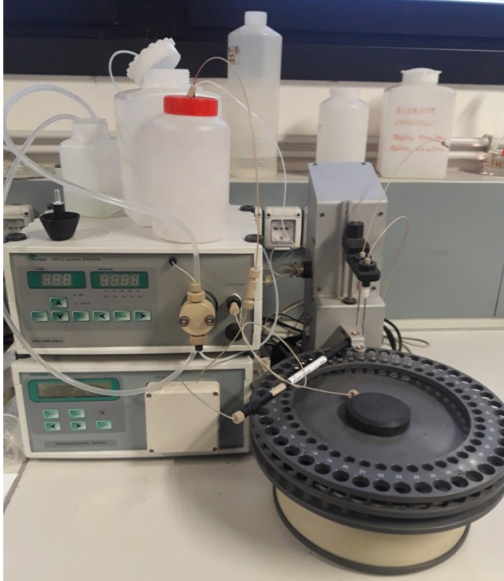
 Figure 8 – Thermo Scientific ICS-900 ion chromatograph and autosampler
Figure 8 –Thermo Scientific ICS-900 ion chromatograph and autosampler
 Figure 9 – Portlab S001.2 ion chromatograph and autosampler
 Figure 10 – Example of chromatogram and calibration curve
 Figure 11 – Benchtop titrator
 Figure 12 – Ultrapure water production unit
GEOCHEMISTRY LABORATORY OF FLUIDS
Supervisor: Dr. Alessandra Sciarra
FLUID GEOCHEMISTRY LABORATORY
Head: Alessandra Sciarra
The Fluid Geochemistry laboratory of the Rome1 Section is equipped with various instruments for the chromatographic analyzes of water and gas and for the determination of the chemical-physical parameters of the water, of the geogas concentrations and for the measurement of the exhalation flows in the countryside.
The Fluid Geochemistry laboratory supports research in a wide range of topics related to environmental impact such as groundwater contamination and assessment of geogas emissions into the atmosphere, analysis of natural gas deposits, characterization of fluids from petroleum and geothermal reservoirs, mineral exploration, natural hazards, as well as monitoring in volcanic and seismically active areas.
The Roma1 Section Fluids Geochemistry Laboratory is equipped with various instruments for water and gas chromatographic analysis, for determination of the chemical-physical parameters of the waters, the geogas concentrations and flux measurement in the field.
The Fluids Geochemistry Laboratory supports research in a wide range of topics related to environmental impact such as groundwater contamination and the evaluation of geogas emissions into the atmosphere, analysis of natural gas deposits, characterization of fluids from oil and geothermal reservoirs, to mineral exploration, to natural hazards, as well as to monitoring in volcanic and seismicly active areas.
Purpose
Maintenance, management and development of the instrumental park for the geochemical characterization of sites of environmental (terrestrial and marine), volcanic and seismic interest.
Provide support to research and monitoring activities carried out within both national and international research and development projects.
Aims
Maintenance, management and development of the fleet instrumental for geochemical characterization of study sites on environmental, volcanic and seismic settings.
Provide support for research and monitoring activities carried out in national and international research projects and development.
All instrument and analysis requests are managed thanks to an electronic calendar available online.
All the requests for instruments and analysis are managed by an electronic calendar available online.
GAS CHROMATOGRAPHY (Head Alessandra Sciarra)
GASCHROMATOGRAPHY (Head Alessandra Sciarra)
Gas chromatography is a widely used analytical method for the separation, identification and quantitative determination of the various components present in a mixture in the gaseous state. This method uses a gas as the mobile phase called carrier gas, usually argon or helium, and exploits the different affinities of the molecules towards two different phases: the stationary phase and the mobile phase. The gas sample is subjected to a flow by the carrier gas (mobile phase) and is directed inside the chromatographic column where there are substances (stationary phase) capable of separating the various components of the gaseous mixture. At the end of the column there are one or more detectors which translate the presence of a substance into an electrical signal. The electrical signal, which can be proportional to the concentration of the detected component or to its mass, is generally transformed into a graph (gas chromatogram, Figure 1).
Gaschromatography is an analytical method widely used for the separation, identification and quantitative determination of the various components present in a mixture in the gaseous state. This method uses a gas as a mobile phase called carrier gas, usually argon or helium, and exploits the different affinities of the molecules towards two different phases: the stationary and the mobile phase. The gas sample is subject to a flow by the carrier gas (mobile phase) and is directed inside the chromatographic column where substances (stationary phase) are present capable of separating the various components of the gas mixture. At the outlet of the column there are one or more detectors that transform the presence of a substance into an electrical signal. The electrical signal, which can be proportional to the concentration of the detected component, is generally transformed into a graph (gas chromatogram, Figure 1).
The gas chromatography laboratory of the Rome1 Section is able to carry out quantitative chemical analyzes of the gaseous species sampled during the gas campaigns in the soil, of the bubbling dry phase from springs or aquifers, of the gases dissolved in the water.
The laboratory is equipped with the following instruments:
1) The Agilent 4900 microGC (Figure 2), a very delicate and high-precision instrument, features a thermal conductivity detector (TCD). This detector matches thermal conductivity differences between the carrier gas and the sample components to be analyzed. In a TCD, the signal generated by the passage of the carrier gas is compared with that of a comparison (equivalent) gas. The passage of the components of the sample inside the detector causes an imbalance of the signal proportional to its concentration.
Inside it has two different types of columns:
1. Molsieve 5Å column having a length of 20 m, and is dedicated to the separation of the following gaseous components: Helium (He), Neon (Ne), Hydrogen (H2), Carbon Monoxide (CO), Nitrogen (N2), Oxygen ( O2) and methane (CH4).
2. PoraPlot Q (PPU) column having a length of 10 m, dedicated to the separation of the following gases: Air, Methane (CH4), Carbon Dioxide (CO2), Acetylene (C2H2), Ethane (C2H6), Ethylene (C2H4) and Acid Sulfuric (H2S).
The concentration of the samples is established on the basis of the calibration curve (Figure 3) and of the previously constructed method, by means of specially analyzed standard gases, with concentrations of the various species varying between a few ppm and 100% by volume.
Gaschromatography Laboratory of the Roma1 Section is able to carry out quantitative chemical analysis of the gaseous species sampled during the soil gas surveys, of the bubbling phase from pools or aquifers, of the dissolved gases in the waters.
Laboratory is equipped with the following instruments:
1) The Agilent 4900 microGC (Figure 2), a very delicate and highly accurate instrument, is equipped with a thermal conductivity detector (TCD). This detector corresponds to differences in thermal conductivity between the carrier gas and the components of the sample to be analyzed. In a TCD the signal generated by the transit of the carrier gas is compared with an equivalent gas. The transit of the sample components inside the detector causes an imbalance of the signal proportional to its concentration.
Inside it has two different types of columns:
1. Molsieve 5Å column having a length of 20 m is dedicated to the separation of the following gaseous components: Helium (He), Neon (Ne), Hydrogen (H2), Carbon Oxide (CO), Nitrogen (N2), Oxygen ( O2) and methane (CH4).
2. PoraPlot Q (PPU) column with a length of 10 m is dedicated to the separation of the following gases: Air, Methane (CH4), Carbon Dioxide (CO2), Acetylene (C2H2), Ethane (C2H6), Ethylene (C2H4 ) and Sulfuric Acid (H2S).
The concentration of the samples is established on the basis of the calibration curve (Figure 3) and the previously constructed method, by means of standard gases with concentrations varying between a few ppm and 100% by volume.
2) The DANI Master TD thermal desorption gas chromatograph, coupled to a gas chromatograph equipped with a DANI Master GC electron capture detector (GC-ECD).
This instrument allows to analyze the perfluorocarbons present in traces in the gases.
Such an analysis can only be performed after sampling from the probe through silicone tubing, and stainless steel tubing (6,35 mm OD × 89 mm) packed with graphitized black CarbotrapTM 100.
2) The DANI Master TD thermal desorption gas chromatograph, coupled with a gas chromatograph equipped with a DANI Master GC electron capture detector (GC-ECD).
This instrument allows to analyze the perfluorocarbons present in traces in the gases.
This analysis can be carried out only after sampling from the probe through a silicone tube, and stainless steel tubes (6.35 mm OD × 89 mm) packed with CarbotrapTM 100 graphitized black.
ION CHROMATOGRAPHY (Head. Daniele Cinti)
ION CROMATOGRAPHY (Head. Daniele Cinti)
Ion chromatography (IC) is an analytical technique that allows the separation and recognition of the chemical constituents of an aqueous solution present in ionic form. The separation takes place through the interaction between a liquid (the mobile phase) and a solid (the stationary phase), which leads to a differential distribution of the components of the solution based on the chemical nature of the substances and their degree of affinity with the two phases (Figure 5). The mobile phase (the eluent) contains and transports the sample to be analyzed and consists of a solution of carbonate and sodium bicarbonate (Na2CO3/NaHCO3) for the analysis of anions and a solution of methanesulphonic acid (CH3SO3H) for that of cations. The stationary phase, contained within the chromatographic column, consists of granules of insoluble porous material carrying reactive groups (amino, carboxylic, sulphonic) on which ions capable of exchanging with the ions of the mobile phase are labilely bound. It is through this process of ion exchange between the ions contained in the stationary phase and those contained in the aqueous solution that the separation of the ions takes place.
Ion-chromatography (IC) is an analytical technique able to separate and recognize the chemical constituents of an aqueous solution present in ionic form. The separation occurs through the interaction between a liquid (the mobile phase) and a solid (the stationary phase), which leads to a differentiated distribution of the components of the solution based on the chemical nature of the substances and their affinity with the two phases (Figures 5). The mobile phase (the eluent) contains and transports the sample to be analyzed and consists of a solution of sodium carbonate and bicarbonate (Na2CO3 / NaHCO3) for the analysis of anions and a solution of methanesulfonic acid (CH3SO3H) for the analysis of cations. The stationary phase, contained within the chromatographic column, consists of granules of insoluble porous material that carry reactive groups (amino, carboxylic, sulphonic) on which ions able of exchanging with the ions of the mobile phase are loosely bound. It is through this process of ion-exchange between the ions contained in the stationary phase and those contained in the aqueous solution that the separation of the ions takes place.
The presence of a detection system (conductometric, infrared, etc.) of the substances leaving the chromatographic column allows to obtain the chromatogram (Figure 6), which is the graphical representation of the separation process through which the components of the solution and its relative concentrations are determined. On the chromatogram each analyte is represented by a peak whose exit time is a function of the speed at which it travels inside the chromatographic column, which depends on the affinity of the substance with the mobile and stationary phases, and whose area is a function of the concentration in solution.
The presence of a detection system (conductometric, infrared, etc.) of the substances leaving the chromatographic column allows to obtain the chromatogram (Figure 6), ie the graphical representation of the separation process through which the components of the solutions are identified and their relative concentrations are determined. On the chromatogram each ion is represented by a peak characterized by an exit time as a function of the speed at which it travels inside the chromatographic column, which depends on the affinity of the substance with the mobile and stationary phases, and an area as a function of its concentration in solution.
The block diagram of a modern ion chromatography system is shown in figure 7. The sample is introduced into the eluent stream via an injection valve, which does not interrupt the flow continuity, and transported through the chromatography column where the separation of the analytes. The analytes present in the sample travel in the column at different speeds and at different times reach a flow detector located downstream of the separation column.
The block diagram of a modern ion chromatography system is shown in figure 7. The sample is introduced into the eluent stream by means of an injection valve, which does not interrupt the continuity of the flow, and is transported through the chromatographic column where the separation of the ions takes place. The ions in the sample solution travel through the column at different speeds and reach at different times a flow detector located downstream of the separation column.
The fluid geochemistry laboratory of the Rome Section1 is equipped with 2 chromatographs: a Thermo Scientific Dionex ICS-900 (Figure 8) and a Portlab S001.2 (Figure 9). Both allow separation with isocratic elution, ie using an eluent whose composition does not vary during the analysis, while the detection takes place in a conductometric cell. In ion chromatography the main anions (F-, Cl-, Br-, NO2-, NO3-, PO43-, SO42-, I-) and cations (Li+,Na+, NH4+, K+, Mg2+, Ca2+) contained in water solution. Applications of ion chromatography are mainly chemical analyzes of natural waters (groundwater, thermal, meteoric, marine) for research purposes and geochemical and environmental monitoring.
The Laboratory of Fluid Geochemistry of the Rome1 Section is equipped with 2 chromatographs: a Thermo Scientific Dionex ICS-900 (Figure 8) and a Portlab S001.2 (Figure 9). Both allow separation with isocratic elution, ie using an eluent whose composition does not vary during the analysis, while the detection takes place in a conductometric cell. In ion chromatography the main anions (F-, Cl-, Br-, NO2-, NO3-, PO43-, SO42-, I-) and cations (Li+,Na+, NH4+, K+, Mg2+, Ca2+) contained in water solution are analysed. Applications of ion chromatography are mainly chemical analysis of natural waters (groundwater, thermal, meteoric, marine) for geochemical and environmental research and monitoring purposes.
Calibration curves (Figure 10) are constructed daily by analyzing standard solutions at different and known concentrations of each ion species. These are used to determine the ionic concentrations of aqueous solutions of unknown concentration.
Calibration curves (Figures 10) are constructed daily by analyzing 6 standard solutions at different and known concentrations of each ionic species. These are used to determine the ionic concentrations of aqueous solutions of unknown concentration.
OTHER EQUIPMENT
OTHER INSTRUMENTS
Other instrumentation used for sampling and analyzing aqueous solutions includes pH meters, conductivity meters and a Metrohm Titrino 785 benchtop titrator (Figure 11). The laboratory is also equipped with a technical balance (3 decimal places), fume hood and Millipore MILLIQ Direct Q-3 System ultrapure water production unit (Figure 12).
Other instrumentation used for sampling and analysis of aqueous solutions includes pH meters, conductivity meters and a benchtop titrator Metrohm Titrino 785 (Figures 11). The laboratory is also equipped with a technical weight scale (3 decimal digits), extractor hood and Millipore MILLIQ Direct Q-3 System ultrapure water production unit (Figures 12).
SITE EFFECTS LABORATORY
Discovering the seismic properties of Rome's subsoil - TGweb GEOSCIENCES News (April 14, 2021)"
"Discovering the seismic properties of the subsoil of Rome - TGweb GEOSCIENZE News (April 14, 2021) "
link to the background document:
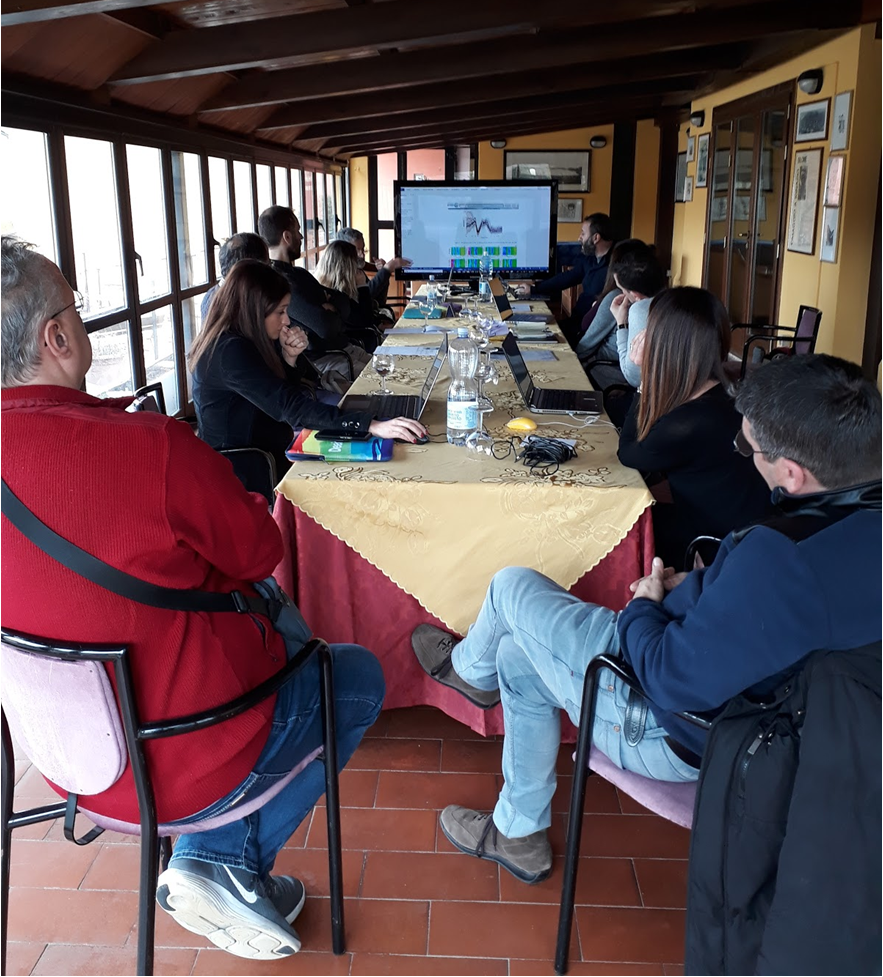 Members of the ESITO Laboratory during an organizational meeting (Avezzano, 21/02/2018)
Personnel of the ESITO Laboratory during an internal meeting (Avezzano, 21/02/2018)
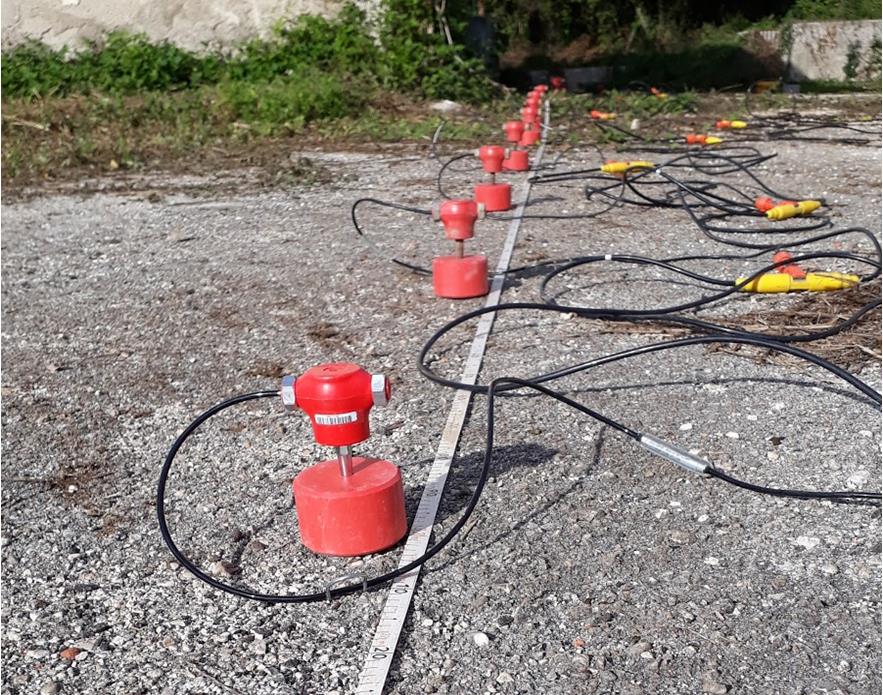 Linear array of vertical geophones for Multichannel Analysis of Surface Waves (MASW; Atina 24/10/2019)
Linear Array of vertical geophones for Multichannel Analysis of Surface Waves (MASW; Atina 24/10/2019)
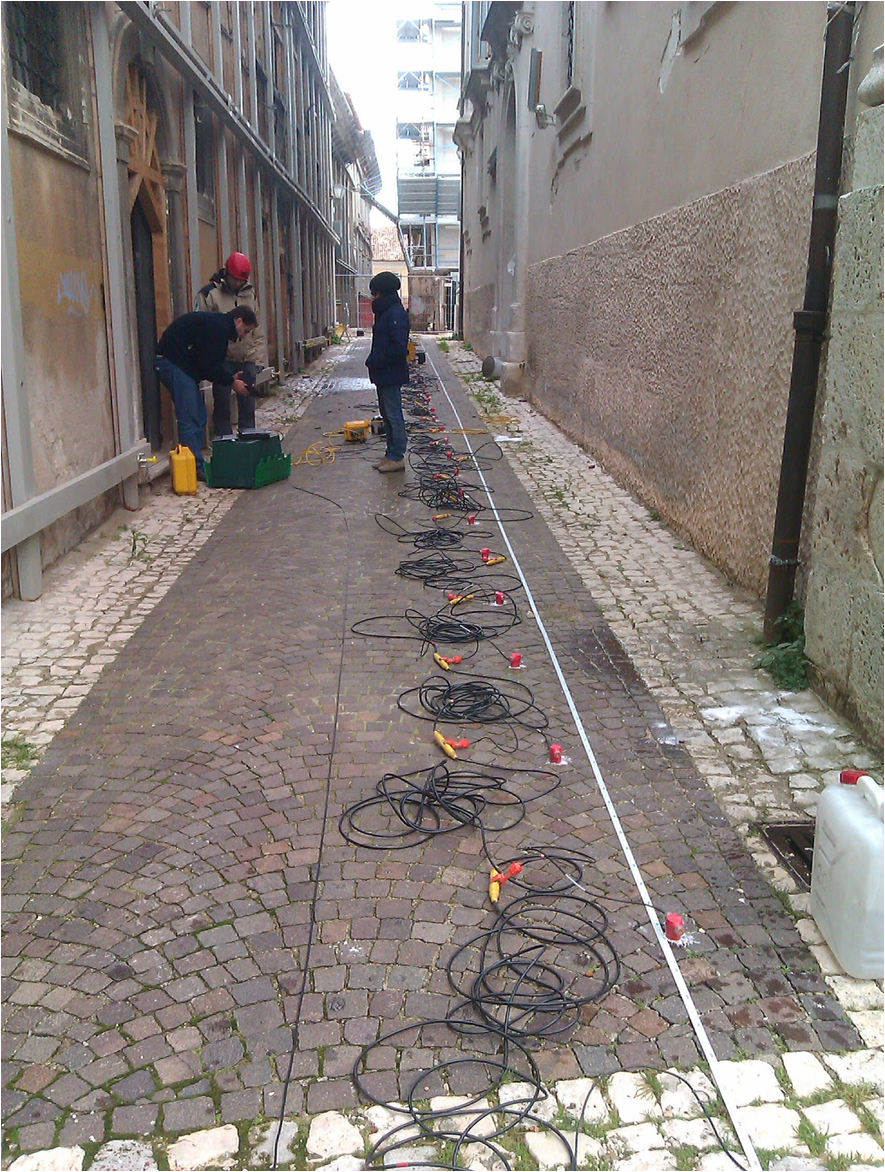 Linear array of vertical geophones for Multichannel Analysis of Surface Waves (L'Aquila 05/12/2012 )
Linear Array of vertical geophones for Multichannel Analysis of Surface Waves (L'Aquila 05/12/2012)
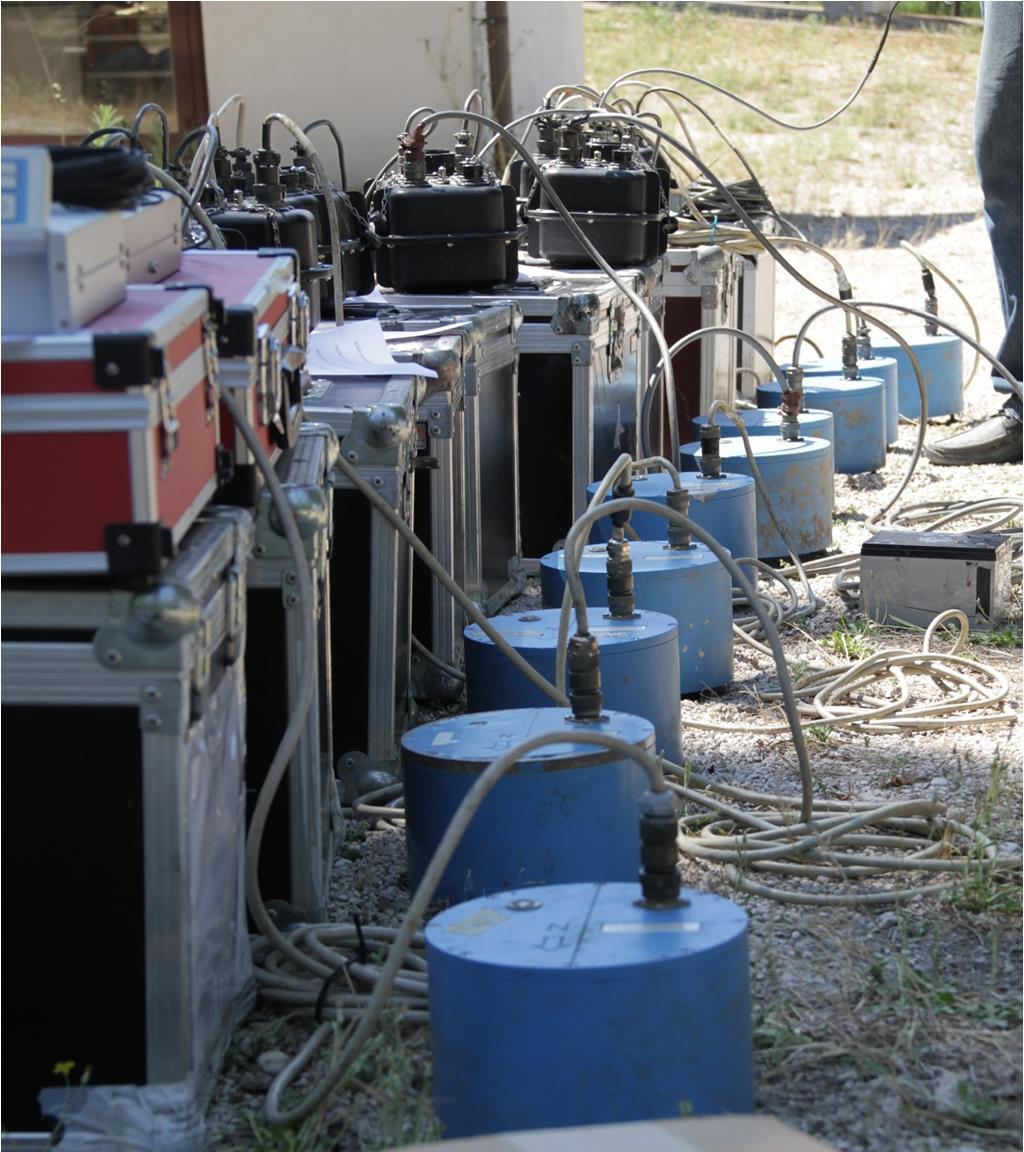 Seismic stations (velocimeters and MarsLite and Reftek130 data loggers) during a huddle test
Seismic stations (velocimeters, accelerometers and MarsLite and Reftek130 digitizers) during an huddle test of the equipment of the laboratory
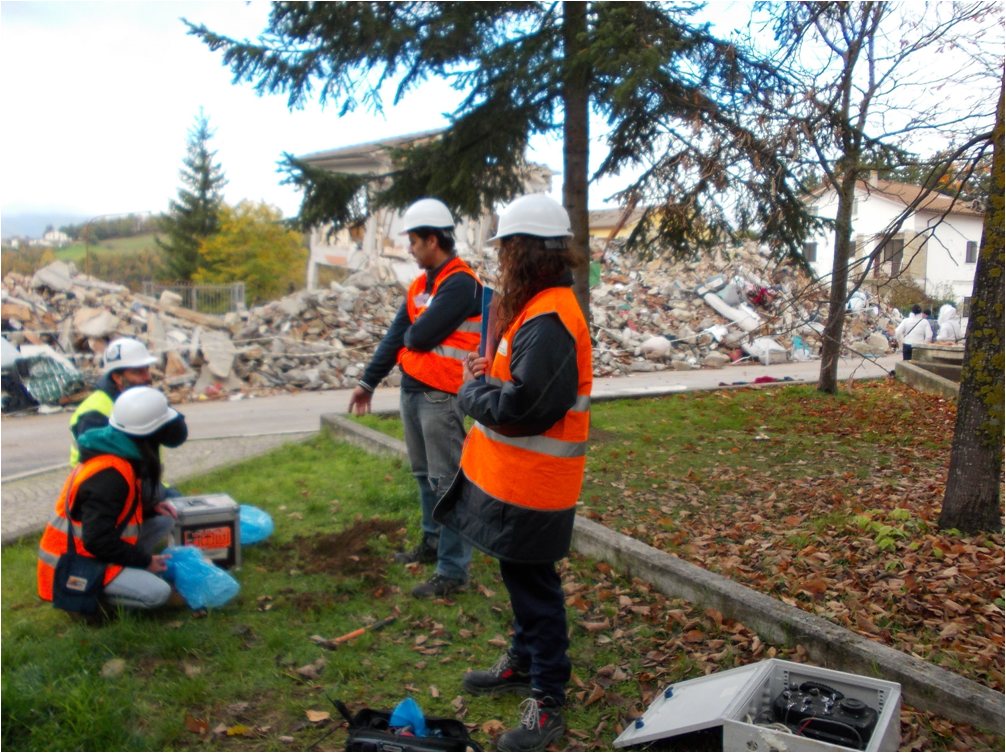
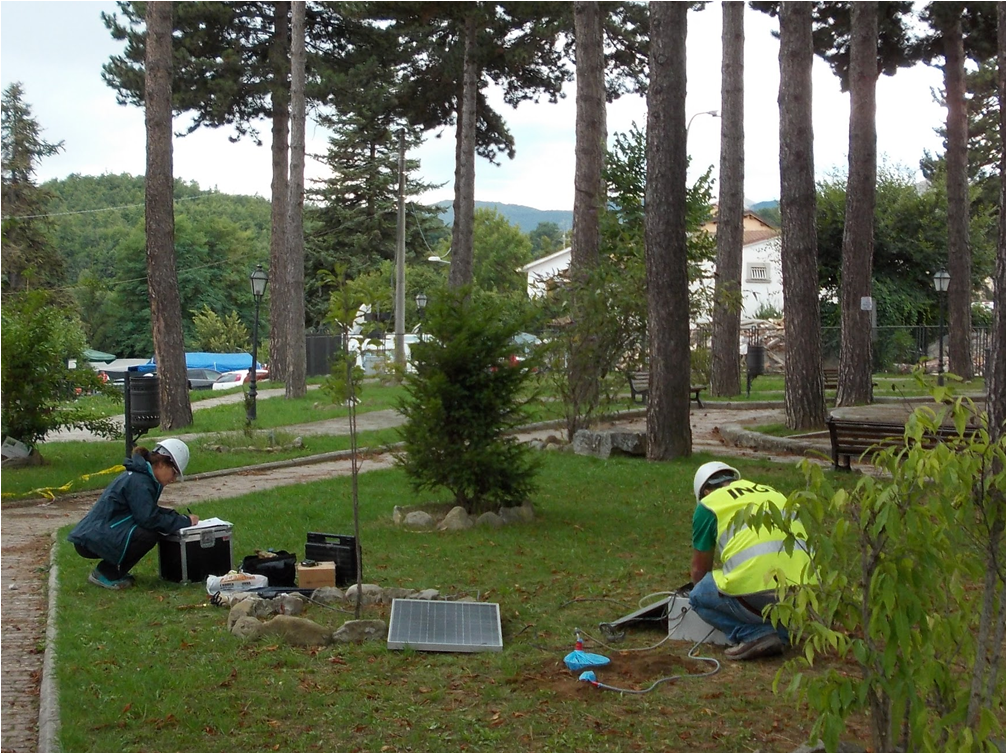 Installation of seismic stations in Amatrice, after the Mw 6.0 earthquake of 24/08/2016 (September 2016)
Installation of seismic stations at Amatrice (network 3A), after the Mw 6.0 earthquake of Central Italy of 24/08/2016 (September 2016)
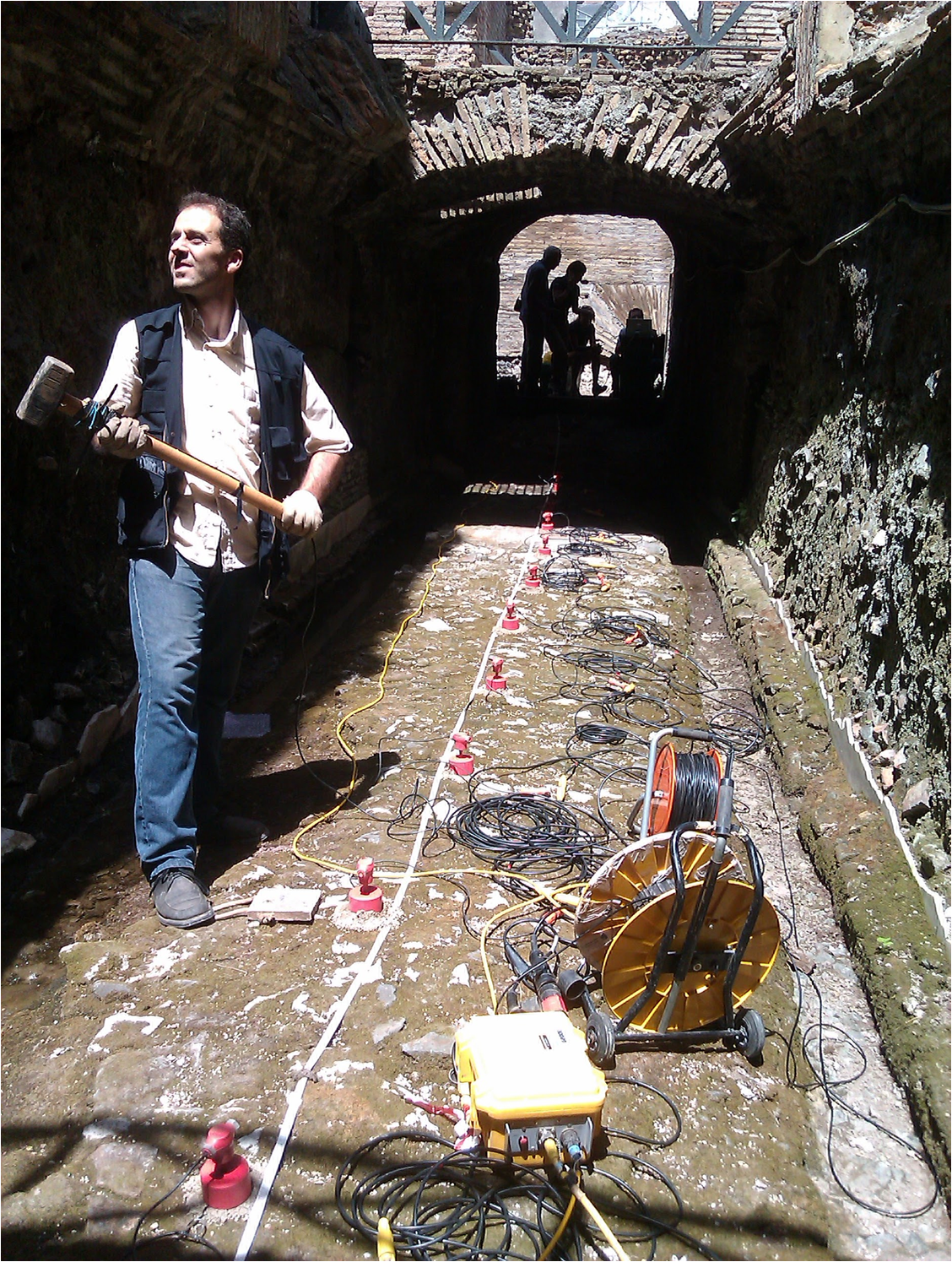 Seismic campaign active in the "Passage of Commodus", Colosseum, Rome, 24/06/2014
Active seismic survey in the “Passage of Commodus”, Colosseum, Rome, 24/06/2014
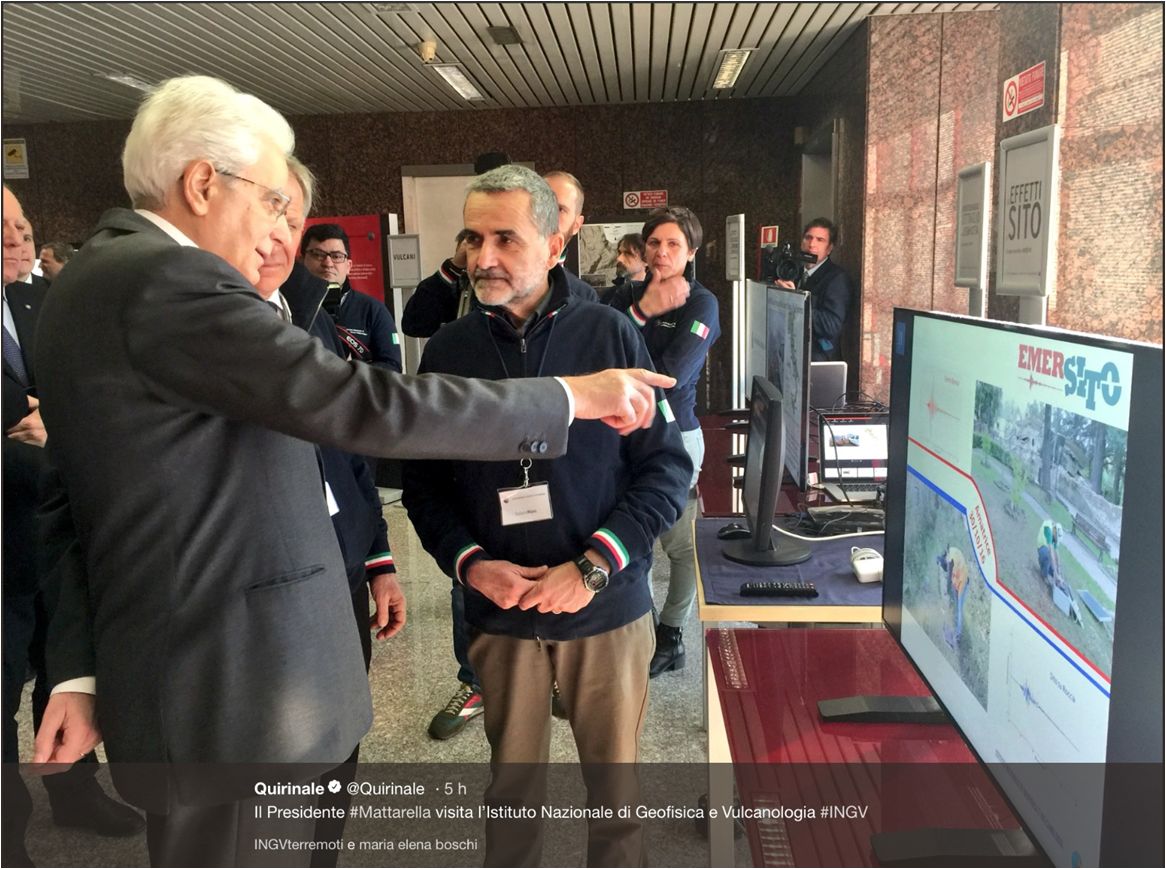 Dissemination activities (visit by the President of the Republic, 24/01/2018)
Open day at INGV. Showing the activity of the team to the President of the Italian Republic Sergio Mattarella, 24/01/2018.
The ESITO laboratory for the study of site effects is part of the infrastructure of the Rome 1 section of the INGV and is equipped with instruments that can be used in the context of research projects and proposals, degree and doctoral theses, service activities concerning the following fields of activity:
● specific local seismic response and site seismic characterization experiments, including sites susceptible to liquefaction phenomena and landslides
● Seismic Microzonation studies (preparatory and training activities)
● seismic emergencies within the emergency groups
● participation in specific experiments for national and international projects or for service activities
● dissemination activities (third mission)
The ESITO Laboratory is divided into three units located in the offices of Rome, Grottaminarda and L'Aquila. The Laboratory ensures the maintenance and correct functioning of the seismic instrumentation located in the three units, and also tests new instrumentation and analysis packages, experimenting with advanced data acquisition systems in the field. Access to and use of the equipment is governed by the following regulation
("SITO Effects Laboratory Regulations Loan request form")
OUTCOME is a laboratory devoted to the study of site effects, and it is one of the infrastructures of the Istituto Nazionale di Geofisica e Vulcanologia (INGV, ROMA1 Section). The laboratory employs seismic instruments that are used in national and international projects and research studies, thesis and emergency activities. In the following the main areas of investigation supported by the ESITO laboratory:
● Specific experiments for the study of local seismic response or seismic site characterization, including sites prone to liquefaction or instability phenomena
● Studies related to Seismic Microzonation
● Seismic emergency (in cooperation with the EMERSITO INGV-emergency group)
● Field experiments within national and international projects
● Participation in workshops and meetings dedicated to public and schools (third mission)
The ESITO laboratory is organized in three units based in the INGV offices of Rome, Grottaminarda and L'Aquila. The laboratory ensures the maintenance and the proper operation of the seismic instruments, and also the testing of new instruments and softwares, including advanced data analysis and acquisition systems in the field surveys. The access and the use of the laboratory equipment is regulated by means of a registered document
(Regulation of ESITO, in Italian , Loan Form).
Site effects
Site Effects
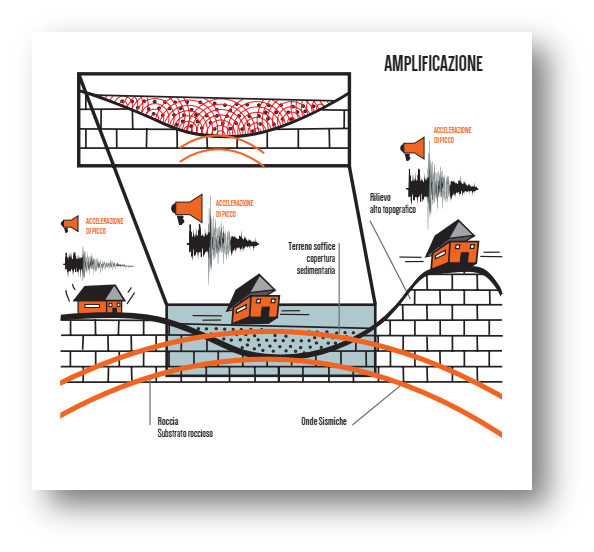
Image taken from the "Guide for animators" of the exhibition "Beware of the Elements. Details that save lives”
Picture redrawn from “Guide for animators” of the event “Beware of the Elements. Details that save lives”
The shaking of the ground is strongly influenced not only by the source of the earthquake and by the propagation path, but also by the geological, geomorphological and geotechnical conditions that the seismic waves encounter as they cross the last layers of soil before reaching the surface. The seismic motion can undergo considerable modifications in terms of amplitude, frequency content and duration of the shaking. All of these variations are referred to as site effects.
For example, the site effects caused by the presence of loosely compact geological formations (alluvials, sedimentary deposits, etc.) on more rigid formations, translate into an amplification of the seismic waves in some frequency ranges, which is as great as the greater the contrast of mechanical properties between the different layers. This type of phenomenon is also known as stratigraphic amplification. Phenomena of aggravation of the seismic motion can also be produced by surface waves that propagate within basins or by the presence of topographic irregularities.
Another relevant phenomenon among the site effects is that caused by the non-linear behavior of the soils, up to liquefaction, which can occur when the seismic wave passes through the soils where there is a sandy level saturated with water and at small depths. .
The ESITO laboratory is an INGV infrastructure with instrumentation and personnel engaged in the study of site effects; their evaluation and knowledge is fundamental for the mitigation of the effects of the seismic action on the building and on the environment.
The ground motion during earthquakes is strongly dependent on the seismic source and travel path of the seismic waves. The geological, geomorphological and geotechnical properties related to the uppermost near-surface layers are also important in modifying the seismograms recorded by seismic stations. The ground shaking in the presence of site effects can be largely amplified with respect to a reference site, in terms of spectral contents, amplitude levels and motion duration. Such magnification phenomena are generally known as site effects.
For example, site effects are mostly observed in the presence of soft deposits characterized by low velocities (alluvial, sedimentary deposits, soft clay, etc..) overlaying stiffer layers: the magnification effect is generally larger when the impedance contrast increases between soft and stiff layers (stratigraphic amplification). Site effects can also be related to multiple reflections and surface waves traveling within the basins, or waves scattered from irregular topographies. A further significant typology of site effects during an earthquake is related to the subsoil non-linearity that can provide liquefaction, with water-saturated unconsolidated sediments that reach a soil rigidity nearly to zero.
The ESITO laboratory groups mostly personnel and seismic instrumentation of INGV-ROMA1 that is focused mainly on study on site effects: research activities and case studies are important to a better knowledge of these phenomena, and to mitigate their effects on the environment, cities and infrastructures .
TEAM
Paola Bordoni, Senior Technologist
Fabrizio Cara, Researcher
Rocco Cogliano, Technical Assistant
Giovanna Cultrera, Senior Researcher
Giuseppe Di Giulio, Senior Researcher (Head of the laboratory)then
Daniela Famiani, Technologist
Antonio Fodarella, Technical Assistant
Alessia Mercuri, Researcher (Responsible of the unit in Rome)
Louis the Great, Technical Assistant
Giuliano Milana, Senior Technologist
Stefania Pucillo, Technologist
Gaetano Riccio, Technologist (Responsible for the unit in Grottaminarda)
Maurizio Vassallo, Researcher (Responsible of the unit in L'Aquila)
Marta Pischiutta, Researcher (Roma2 section)
Luca Minarelli, Technologist
Sara Amoroso (Researcher from University of Chieti-Pescara associated with INGV)
Salomon Hailemikael (Researcher)
Lab Unit Milan Section (from June 2025)
Sara Lovati, Senior Technologist (Head of the Milan Unit)
Francesca Pacor, Senior Researcher
Marco Massa, Senior Researcher
Pellegrino Moretti, Technical Collaborator
Nicolò Carra, Technical Collaborator
Anna Figlioli, Technical Collaborator
Rodolfo Puglia, Senior Technologist
Lucia Luzi, Senior Researcher
Vera Pessina, Senior Researcher
Giovanni Lanzano, Senior Researcher
Giulio Brunelli, Researcher
RESEARCH PROJECTS
Contributing projects to the laboratory or supported by the ESITO laboratory.
304 Conv. INGV-DPC (Annex A Emergencies WP 9.2);
520 Conv. Molise region "Seismic microzonation of inhabited areas in the province of Isernia - Research collaboration - scientific support";
542 FIRB-Abruzzo "High resolution surveys for the estimation of seismic hazard and risk in the areas affected by the earthquake of 6 April 2009";
865 FISR-2016 "Center for the study and monitoring of natural risks in central Italy";
972 Conv. INGV-DPC B2 2019-21, WP1 Task 2 "Characterization of accelerometric sites";
905 MZS Amatrice "Propaedeutic activities for seismic microzonation of the Municipality of Amatrice";
906 MZS Casamicciola “Propaedeutic activities for seismic microzonation of the Municipality of Casamicciola Terme (NA);
911 MZS UMBRIA-MARCHE-LAZIO-ABRUZZO "Third level seismic microzonation of the municipalities affected by the earthquakes of 24 August 2016 and 26 and 30 October 2016".;
929 EDI-SECUR “Development of an innovative optical sensor for monitoring the dynamic behavior of buildings in seismic areas”;
947 MISE-DGSAIE “Operational agreement between MISE DGSAIE and INGV for studies on the seismic response of the Sulmona booster plant area”;
963 Avezzano Level 3 Microzonation “Agreement for the realization of geophysical surveys to support Level 3 Seismic Microzonation in the Municipality of Avezzano (Aq)”;
979 PON-GRINT “European plate observing system GRINT”;
1011 MZS-III ISCHIA “Level-III seismic microzonation Municipalities of Casamicciola Terme, Lacco Ameno and Forio”;
FACILITIES
The instrumentation is organized and managed in three units of INGV (Roma, L'Aquila and Grottaminarda) and is actually composed of :
- seismic digitizers (Reftek 130, Lennartz Marslite, Quanterra Q330 and Kinemetrics Etna)
- accelerometers and velocimeters (Kinemetrics Episensor, Lennartz 5s)
- multi-channel system (three Geodes by Geometrics) with vertical and horizontal geophones; set of cables with different spacings, tools (sledge hammer and plates) for active shots to generate P and S waves, minigun source etc.
- system for electric tomography (Syscal R2 equipment managed in cooperation with Roma2 Section)
- other devices and dedicated tools such as batteries, solar panels, gps, tablets, mass storages, etc..
- more than 100 seismic nodes (Geospace Technologies)
.
ACTIVITIES (since 2016)
List of experiments
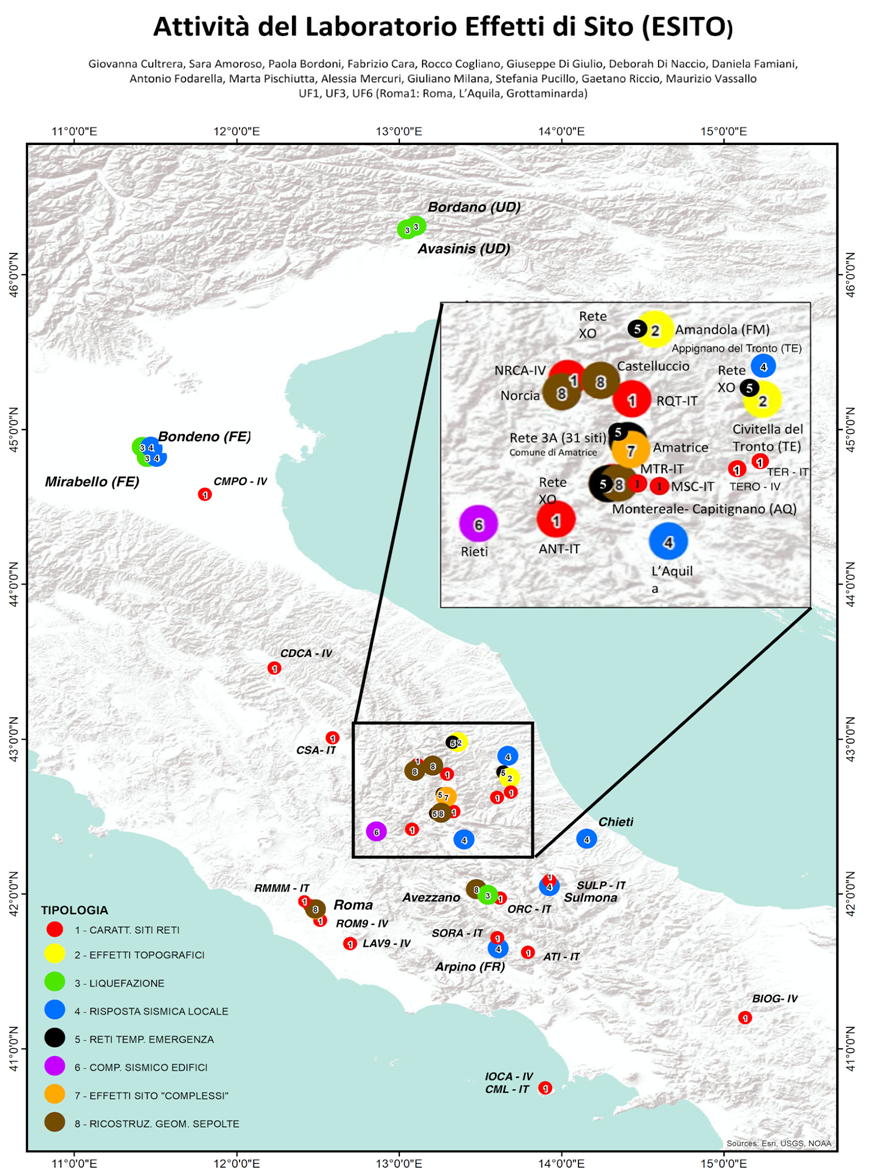
- Seismic characterization of stations (within activity of DPC_INGV All B2): Campotto Po CMPO-IV, Città di Castello CDCA-IV, Castelnuovo Assisi CSA-IT, Norcia NRCA-IV, Arquata RQT-IT, Montereale MTR-IT, Mascioni MSC- IT, Antrodoco ANT-IT, Rome headquarters ROM9-IV, Lanuvio LAV9-IV, Ortucchio ORC-IT , Ischia IOCA-IV and CML-IT, TERO-IV, TER-IT, , BIOG-IV, SULP-IT , ATI -IT, SORA-IT, RMMR-IT
- Topographic effects: Amandola, Civitella del Tronto and Montereale (EMERGED)
- Sites prone to liquefaction: Bondeno (FE) and Mirabello (FE) with blast tests, Avezzano, Bordano (Udine)
- Seismic local response: Bondeno (FE) and Mirabello (FE) for blast test, L'Aquila, Chieti, Sulmona and Arpino
- Temporary network installed during seismic emergency (cooperation with EMERSITO): Network XO of Amandola, Civitella del Tronto and Montereale, Network 3A with 31 stations installed for microzonation activity (EMERSITO)
- Building analysis: Rieti with EdiSECUR Project
- “Complex” site effects: Amatrice
- Reconstruction of buried geological geometry: Castelluccio di Norcia, Norcia, Castelnuovo Assisi, Avezzano , Rome
List of peer-reviewed papers (with the support of the laboratory)
2020
- Di Giulio, G., Ercoli, M., Vassallo, M. and Porreca, M., 2020. Investigation of the Norcia basin (Central Italy) through ambient vibration measurements and geological surveys. Engineering Geology, 267, p.105501.
- Famiani, D., Brunori CA, Pizzimenti L., Cara F., Caciagli M., Melelli L., Mirabella F., Barchi MR 2020, Geophysical reconstruction of buried geological features and site effects estimation of the Middle Valle Umbra basin ( central Italy) Engineering Geology, 269,, p. 105543
- Di Naccio, D., Famiani, D., Liberi, F., Boncio, P., Cara, F., De Santis, A., Di Giulio, G., Galadini, F., Milana, G., Rosatelli , G., Vassallo M. 2020, Site effects and widespread susceptibility to permanent coseismic deformation in the Avezzano town (Fucino basin, Central Italy): Constraints from detailed geological study, Engineering Geology, 270,, p. 105583
- Rollins, KM, Amoroso S., Milana, G., Minarelli, L., Vassallo, M., and Di Giulio G. 2020. Gravel Liquefaction Assessment Using the Dynamic Cone Penetration Test Based on Field Performance from the 1976 Friuli Earthquake, Journal of Geotechnical and Geoenvironmental Engineering 146(6),
2019
- Cara, F., Cultrera, G., Riccio, G., Amoroso, S., Bordoni, P., Bucci, A., D'Alema, E., D'Amico, M., Cantore, L., Carannante, S. and Cogliano, R., 2019. Temporary dense seismic network during the 2016 Central Italy seismic emergency for microzonation studies. Scientific data, 6(1), pp.1-15.
- Milana, G., Cultrera, G., Bordoni, P., Bucci, A., Cara, F., Cogliano, R., Di Giulio, G., Di Naccio, D., Famiani, D., Fodarella, A. and Mercuri, A., 2019. Local site effects estimation at Amatrice (Central Italy) through seismological methods. Bulletin of Earthquake Engineering, pp.1-27.
- Priolo, E., Pacor, F., Spallarossa, D., Milana, G., Laurenzano, G., Romano, MA, Felicetta, C., Hailemikael, S., Cara, F., Di Giulio, G. and Ferretti, G., 2019. Seismological analyzes of the seismic microzonation of 138 municipalities damaged by the 2016–2017 seismic sequence in Central Italy. Bulletin of Earthquake Engineering, pp.1-41.
- Marcucci, S., Milana, G., Hailemikael, S., Carlucci, G., Cara, F., Di Giulio, G. and Vassallo, M., 2019. The deep bedrock in Rome, Italy: a new constraint based on passive seismic data analysis. Pure and Applied Geophysics, 176(6), pp.2395-2410.
- Vassallo, M., De Matteis, R., Bobbio, A., Di Giulio, G., Adinolfi, GM, Cantore, L., Cogliano, R., Fodarella, A., Maresca, R., Pucillo, S and Riccio, G., 2019. Seismic noise cross-correlation in the urban area of Benevento city (Southern Italy). Geophysical Journal International, 217(3), pp.1524-1542.
2018
- Amoroso, S., Gaudiosi, I., Tallini, M., Di Giulio, G. and Milana, G., 2018. 2D site response analysis of a cultural heritage: the case study of the site of Santa Maria di Collemaggio Basilica (L'Aquila, Italy). Bulletin of Earthquake Engineering, 16(10), pp.4443-4466.
- Boncio, P., Amoroso, S., Vessia, G., Francescone, M., Nardone, M., Monaco, P., Famiani, D., Di Naccio, D., Mercuri, A., Manuel, MR and Galadini, F., 2018. Evaluation of liquefaction potential in an intermountain Quaternary lacustrine basin (Fucino basin, central Italy). Bulletin of Earthquake Engineering, 16(1), pp.91-111.
- Theodoulidis, N., Cultrera, G., Cornou, C., Bard, PY, Boxberger, T., Di Giulio, G., Imtiaz, A., Kementzetzidou, D., Makra, K. and Argostoli NERA Team, 2018. Basin effects on ground motion: the case of a high-resolution experiment in Cephalonia (Greece). Bulletin of Earthquake Engineering, 16(2), pp.529-560.
2017
- Durante, F., Di Giulio, G., Tallini, M., Milana, G. and Macerola, L., 2017. A multidisciplinary approach to the seismic characterization of a mountain top (Monteluco, central Italy). Physics and Chemistry of the Earth, Parts A/B/C, 98, pp.119-135.
- Riccio, G., Cogliano, R., Di Giulio, G., Fodarella, A., Pucillo, S. and Rovelli, A., 2017. A study of building vibrations induced by weak motions: effects of earthquake excitation, ambient noise and wind speed. Annals of Geophysics, 10.4401/ag-7149
- Di Naccio, D., Vassallo, M., Di Giulio, G., Amoroso, S., Cantore, L., Hailemikael, S., Falcucci, E., Gori, S. and Milana, G., 2017. Seismic amplification in a fractured rock site. The case study of San Gregorio (L'Aquila, Italy). Physics and Chemistry of the Earth, Parts A/B/C, 98, pp.90-106.
- Pischiutta, M., Villani, F., D'Amico, S., Vassallo, M., Cara, F., Di Naccio, D., Farrugia, D., Di Giulio, G., Amoroso, S., Cantore, L. and Mercuri, A., 2017. Results from shallow geophysical investigations in the northwestern sector of the island of Malta. Physics and Chemistry of the Earth, Parts A/B/C, 98, pp.41-48.
- Hailemikael, S., Milana, G., Cara, F., Vassallo, M., Pischiutta, M., Amoroso, S., Bordoni, P., Cantore, L., Di Giulio, G., Di Naccio, D. and Famiani, D., 2017. Sub-surface characterization of the Amphiteatrum Flavium Area (Rome, Italy) through single-station ambient vibration measurements. Annals of Geophysics, 60(4), p.0438.
- Amoroso S., Milana G., Rollins, KM, Comina, C., Minarelli L. et al., 2017. The first Italian blast‐induced liquefaction test (Mirabello, Emilia‐Romagna, Italy): Description of the experiment and preliminary results. Annals of Geophysics, 60(5):S0556, https://doi.org/10.4401/ag-7415
2016
- Cultrera, G., D'Alema, E., Amoroso, S., Angioni, B., Bordoni, P., Cantore, L., Cara, F., Caserta, A., Cogliano, R., D' Amico, M. and Di Giulio, G., 2016. Site effect studies following the 2016 Mw 6.0 Amatrice earthquake (Italy): the Emersito Task Force activities. Annals of Geophysics, 59.
- Di Giulio, G., de Nardis, R., Boncio, P., Milana, G., Rosatelli, G., Stoppa, F. and Lavecchia, G., 2016. Seismic response of a deep continental basin including velocity inversion : the Sulmona intramontane basin (Central Apennines, Italy). Geophysical Journal International, 204(1), pp.418-439.
Miscellaneous (International Meeting and Report)
- Milana, G., Cultrera G., Cogliano R., Pucillo S., Riccio G., 2019. Velocity profile report at the seismic stations IT.ATI – Atina (FR), http://hdl.handle.net/2122/12970
- Famiani, D., Cultrera, G., Cara, F., Di Giulio, G., Milana, G., Todrani, A., Vassallo, M., Amoroso, S., Bordoni, P., Cogliano, R and Di Naccio, D., 2019. Site effects estimation and their effects on strong ground motion at Amatrice village (Central Italy). In AGU Fall Meeting 2019.
- Cultrera G., Bordoni P., Casale P., Cara F., Di Giulio G., Famiani D., Ladina C., Pischiutta M., Quintiliani M., Pacor F. and Site Characterization Team (2018). Site characterization database of INGV Italian seismic network. S34 - Developments in Strong Motion Seismology, at COSMOS Session. ESC-S34-872. The European Seismological Commission ESC2018 36th General Assembly, 2-7 Sept. 2018, Valletta, Malta.
- Vassallo, M., Milana G., Di Giulio G., Bordoni P., Cogliano R., Fodarella A., Pucillo S., Riccio G., 2018, Velocity profile report at the seismic stations IV.IOCA and IT. CML - Casamicciola Terme, Ischia, doi: 10.5281/zenodo.2281844, doi: 10.5281/zenodo.2281845
- P. Bordoni, F. Pacor, P. Casale, G. Cultrera, F. Cara, G. Di Giulio, D. Famiani, C. Ladina, M. Pischiutta, M. Quintiliani, and the Site Character Team (2017) . Site characterization of the national seismic network of Italy. European Geosciences Union (EGU) General Assembly, Vienna, Austria, April 2017. In EGU 2017 General Assembly Abstracts (Vol. 19, p. 18604).
- Cultrera, G., Famiani, D., Milana, G., Amoroso, S., Angioni, B., Bordoni, P., Cara, F., Cogliano, R., D'Amico, M., Di Giulio , G. and Di Naccio, D., 2017. EMERSITO operational group - seismic event ISCHIA 2017: Report n. 1 23/08/2017.
dissemination
- Participation to the exhibition “Beware of the elements! Details that save lives”, Grottaminarda (AV), 22 November 2019 - 31 January 2020,
- Scientific partner in the framework of the Ruritage project (Heritage for Rural Regeneration https://www.ruritage.eu/project/, Horizon 2020). A pair of seismic stations (in borehole and at surface) was installed in the municipality hub of Appignano del Tronto, (AP, Italy), 13-14 November 2019, http://www.adriaticonews.it/2019/11/15/appignano-del-tronto-citta-resiliente-si-lavora-allaction-plan/
- Training Course Order of Geologists of Lazio, "Non-invasive techniques to support local seismic response studies", Rome, Sala INGV, 16-5-2019
- Meeting with the school " Colecchi-Da Vinci L'Aquila Surveyors Institute", Seismic Microzonation Seminar, 22 February 2019, http://www.ilcapoluogo.it/2019/03/07/microzonazione-sismica-ricostruzione-e-pianificazione-territoriale-allistituto-per-i-geometri/
- INGV Open Day - "Earthquakes between memory and prevention", INGV, 20 January 2019
- Pint of Science L'Aquila 2018, Cafè Garibaldi "The seismology of bins: from a small-scale experiment to seismic microzonation", 14 May 2018 https://pintofscience.it/event/la-sismologia-dei-bidoni-da-un-esperimento-a-piccola-scala-alla-microzonazione-sismica
- INGV initiative "Together to live with earthquakes" in Amatrice (29/10/2017)
- "Open doors to INGV: one year after the Amatrice-Visso-Norcia seismic sequence", INGV of Rome (24/08/2017)
- Participation to “European Researchers' Night ” in L'Aquila within SHARPER project (EU Project within Marie Skłodowska-Curie Horizon 2020 - GA 722981): 25/09/2015, 30/09/2016, 29/09/2017, 28 /9/2018, 27/9/2019

HPHT LAB

Field emission electron microscope

Experimental laboratory

Experimental laboratory

Analog laboratory: ash resuspension experiment in the wind tunnel
In recent decades, the rapid development of knowledge on technology and materials science has made it possible to build instruments capable of reproducing the environmental conditions that control the dynamics of chemical-physical processes inside and on the earth's surface. Among these processes, those relating to seismicity and magmatism-volcanism are of particular economic and social importance due to the number of victims and the extent of damage they cause.
In this context, the Laboratory for High Pressures and High Temperatures of Experimental Geophysics and Volcanology has been developed at the Rome 1 Section of the INGV.
The experimental study of petrological, geophysical and volcanological processes that occur inside and on the surface of the Earth is the objective of the Laboratory which has developed into two main sectors, microanalytical and experimental. The microanalytical sector is fundamental for the characterization of materials. It is equipped with an electron microprobe for the compositional study of geological and experimental materials and a field emission electron microscope for high resolution textural and morphometric analyses. The laboratory is available to a large number of both INGV and external researchers.
On average, 30 research proposals concerning the study of earthquakes, volcanic eruptions and the properties of materials are developed every year. The experimental sector is made up of many apparatuses which have also partly been developed within the laboratory itself. The main applications concern (i) the study of the chemical-physical properties of magmas, (ii) the study of the physical properties of rocks and (iii) the analogical approach to the study of eruptive dynamics and fracture.
Both Italian and foreign researchers and technologists work in the laboratory and today it represents an international point of reference for experimental research in the geophysical and volcanological sector. Every year researchers from all over the world are hosted, while the training activity for students from Italian and foreign universities is guaranteed through internships, degree theses and research doctorates. Since 2004, the development of the Laboratory for High Pressures and High Temperatures has seen the implementation of numerous national and international projects which in some cases see the laboratory itself also involved as a host institution.
The High Pressure-High Temperature Laboratory of the Istituto Nazionale di Geofisica e Vulcanologia of Rome (hereafter HPHT Lab) is a multidisciplinary facility originally founded in 2002.
The HPHT Lab includes three areas of investigation: 1) experimental testing of natural and synthetic materials; 2) microanalytical and physical analyses; 3) analog experiments. Volcanology, petrology, mineralogy, seismology, and rock physics are the main, broad areas of research at the HPHT Lab.
Concerning the experimental investigations, research in magma evolution and rheology, and on mantle petrology are carried out with high-pressure and high-temperature apparatus, including furnaces, piston-cylinder, and multi-anvil devices, covering conditions from surface eruption of magma to middle mantle.
The frictional properties of faults and rocks are investigated under a wide range of slip rates and dynamics and under variable boundary conditions using unique rotary shear apparatus and large-scale bi-axial press. In addition, rock physics/mechanics studies, from rock permeability to fracturing and degassing can also be investigated with the above apparatus and with more classical devices.
The analytical facilities include a Field-Emission Scanning Electron Microscope and an Electron Micro Probe Analyzer specifically tuned for natural rock analyses. Accessory to these are an helium pycnometer, particle size analyzer, sieves, and other basic instruments.
The analog investigations are carried out in a specific area where ad-hoc, temporary set-ups are developed. Analog materials are characterized using a rheometer, and the experiments are recorded and analyzed using a range of visual documentations, spanning from time-lapse cameras to high-definition and high-speed camcorders.
The analog laboratory focuses mostly on explosive volcanism and the related products and processes, including the formation and release of Taylor bubbles, pyroclast ejection during supersonic eruptions, and the sedimentation and aggregation of volcanic ash particles.
The HPHT Lab also hosts and develops new systems for the in-situ study of explosive volcanic eruptions by combining high-speed, high-definition imaging in the visible and thermal infrared wavelengths with acoustic recording. Investigated processes cover the ejection of volcanic ash and bombs, their setting and potential hazard, the sources of volcanic sound, and shifting styles of explosive volcanic activity.
The sharing of facilities and working space in between researchers with such a broad variety of backgrounds is a key component of the HPHT Lab, eventually leading to interdisciplinary exchange, facilitating the development of new projects, and ultimately promoting a stimulating research environment.
Annual Report 2023 | Annual Report 2022 | Annual Report 2021 | Annual Report 2020 | Annual Report 2019 | Annual Report 2018 | Annual Report 2017 | Annual Report 2016 |
TEAM
Stefano Aretusini | Contract Researcher
Emanuela Bagnato | Researcher
Riccardo Civico | Researcher
Chiara Cornelio | Contract Researcher
Gianfilippo De Astis | Senior Researcher
Elisabetta Del Bello | Researcher
Fabrizio Di Fiore | Contract Researcher
Giuseppe La Spina | Researcher
Valeria Misiti | Technologist
Manuela Nazzari | Researcher
Francesco Pennacchia | Contract Technician
Alessio Pontesilli | Contract Researcher
Giacomo Pozzi | Contract Researcher
Tullio Ricci | Researcher
Elena Spagnuolo | Researcher
Laura Spina | Researcher
Jacopo Taddeucci | Senior Researcher
Giancarlo Tamburello | Researcher
Piergiorgio Moschini | postdoc
FACILITIES
Multiple press 840 tons | Voggenreiter
Piston cylinder - 3/4” and 1” pressure plates | Voggenreiter
Multianvil - Walker type 6/8 | Voggenreiter
Quick Press - Piston Cylinder 3/4” and 1” pressure plates | Depth of the Earth
Bi-Tri-Axial Press (BRAVA) | RMP - ENG
Low to High Velocity Apparatus (SHIVA) | RMP - ENG
Electron microprobe equipped with 5 WDS and 1 EDS | JEOL JXA-8200
Field Emission Electron Microscope equipped with EBSD and STEM | Termofischer Scios 2 LV
Car Carbon Coater | JEOL JEC-530
Fine coater | JEOL JFC-2300HR
High and low temperature furnaces | lenton
Impedance analyzer | Solartron SI1260
Digital oscilloscope | Tektronix DPO4032
Wave generator | Agilent 33250A
H-Frame presses 10 ton | enerpac
Precision balance | Sartorius
Optical and stereo microscopes | Leica DMRXP and Euromex
Ultra-high velocity, intensified, gated digital camera | Cordin 204-2
Stereomicroscopes | Leica MZ9.5
Semi-automatic polisher | Buehler Minimet 1000
Power Supplies | Agilent 6575A
Helium Pycnometer | AccuPyc II 1340
Permeameter with double intensifier | Rock Physics
Rheometer MCR 301 Physics | Anton Parar
Vertical Furnace RHTV 120-300/18 | Nabertherm
High Temperature Furnace LHT 04/18 | Nabertherm
Cecchi data acquisition system | Applied Seismology
Rock drilling, cutting, and grinding equipment for sample preparation
Thermal High Speed Camera | FLIR SC645
Welder PUK U3 | Lampert
Laser line generator | Edmund optics
Precision test sieves | Endecotts
MGL-III Laser, 532nm 200mW, PSU-III-LED/Unit | Changchun New Industries
Multi-Wavelength Analyzer LUMiReader® PSA with Particle sizing according to ISO 13317
2 Polarized Free-field Microphones 40AN 1/2", Low Frequency (0.5Hz - 20kHz) | GRAS
Ext. Polarized Pressure Microphone 46DP-1 1/8", High Frequency (6.5Hz -140kHz) | GRAS
Pirani PVG-500 vacuum gauge
Petrographic microscope ECLIPSE E-50i POL | Nikon
Drying oven UF 75 | Memmert
4K digital camcorders | sony
High Speed digital camcorder HX6 | NAC Memrecam
Shock-tube apparatus (Jet-Buster) | INGV
High-speed digital camcorders | NAC 512 SC, Optronis CR600x2, NAC HX6, NAC HX3
Laser Range Finder | Vettronix VECTOR 21
Time Lapse Camera with 24-70 lens | Brinno TLC200 Pro
Precision Syringe Pumps | ISCO
Ash dispersal/settling apparatus (Ash-Buster) | INGV
Drone Matrice 300 RTK | DJI
Mavic 2 Pro Drone | DJI
Phantom 4 RTK Drone | DJI
Drone Mini 2 | DJI
Dual UV cameras 340 UVGE | Thorlabs
Laboratory sieve shaker Octagon 200 | Endecotts
Optical Profilometer Modus6ZS-3D | DeltaPIX
Triaxial ICP accelerometer | PCB PIezotronics
Two high frequency ICP pressure sensors | PCB PIezotronics
Three ceramic shear ICP accelerometers | PCB PIezotronics
Two 4-channel ICP sensor signal conditioners | PCB Piezonotrics
MEERA biaxial direct shear apparatus | INGV/TEES
High-temperature, vacuum, inert, and reactive gas furnace
Microdriller for experimental glasses | ARNOLD 561/01
Mortar grinder for experimental glasses | PULVERISETTE 23 FRITSCH
SKO-D XL Orbital Shaker | SKO
Centrifuge Neya 8 Basic | NEYA
DANTE I Carbolite Gero | Verder Scientific
SKATE (Setup for the Kinematic Acquisition of Explosive Eruptions) | INGV/TEES
FBG interrogator DM-8120 | HELD
RESEARCH PROJECTS
- National Recovery and Resilience Plan - Next Generation Europe Program: Monitoring Earth's Evolution and Tectonics Project MEET | WP 3 Integrated Laboratories for the Geosciences and the Environment ILGE | WP leaders P. Scarlato - F. Funiciello
- MIUR PRIN Project 2017 | Scales of solidification in magmas: applications to volcanic eruptions, silicate melts, glasses, glass-ceramics | PIM Carroll
- MIUR PRIN Project 2022 | TRIALS: an integrated PetRO-Volcanological monitoring approach applied to Mt. Etna and Stromboli - 2022N4FBAA | PIM Masotta
- MIUR PON | GRINT | PIG Puglisi
- European research project | EXCITE 2 'Electron and X-ray microscopy Community for structural and chemical Imaging Techniques for Earth materials' | PI Utrecht University
- European research project | Marie Sklodowska-Curie European Training Network IMPROVE, Innovative Multi-disciplinary European Research training network on VolcanoEs | Papal PIP
- INGV "Free research" Project | Magma dynamics triggering the 3 July and 28 August 2019 paroxysms at Stromboli volcano: A comparative approach based on the ascent rates, timescales and PT-H2O paths of magma | PIP Scarlet
- INGV "Free research" Project | FRAGMENTS, FRAgmentation of Mafic Magmas: ExteNt and TIming | PIJ Taddeucci
- INGV “Free research” Project | ROUGHER, expeRimental Observations aboUt irregular cHannel geometRies| GDP Plug
- INGV Departmental Strategic Projects | UNO - UNderstanding the Ordinary to predict the extraordinary: An integrated approach for studying and interpreting the explosive activity at Stromboli volcano | PIP Scarlet
- ASI-INAF Project | “Exoplanets” | PIG De Astis
- ERC Syn Fear | Fault activation and Earthquake Rupture | PID Giardini, F. Amman, M. Cocco, S. Wiemer
- Marie Sklodowska-Curie Individual Fellowship | “Experiments, Numerical modeling and field observations of basaltic maGmA fragMEntation (ENDGAME)” | PIJ Taddeucci, G. La Spina
- INGV “Dynamic Planet” Project | DYNAMO DYNAmics of eruptive phenoMena at basaltic volcanoes | GDP Zuccarello
- INGV “Dynamic Planet” Project | CAVEAT | PIM Palano
- IRGIE Inventory of Geothermal Resources of the Aeolian Islands. estimate of potential and proposals for use | PIM Procesi
- INGV “Dynamic Planet” Project | Sibyl | PIA Pignatelli

WORKSHOPS
The INGV laboratories constitute an important infrastructural heritage and a pole of attraction for researchers and study groups from Italian and foreign institutions. In this sense, INGV has invested significantly
in technological innovation, in the commissioning and maintenance of state-of-the-art equipment, as well as in the experimentation and development of innovative analytical and experimental methods that can improve the quality and quantity of measurements, reducing acquisition and calculation and facilitating the usability of data for the entire scientific community. All these activities have been organized in the INGV in the form of workshops. The laboratory is therefore not only a physical place where the apparatuses are located and where analytical and experimental activities take place, but it is also a dynamic structure where, by producing technological and methodological developments, research activities are implemented and harmonized.
In the analytical and experimental laboratories of the Rome office, studies are carried out in the following sectors:
- Physics and chemistry of rocks
- Paleomagnetism and environmental magnetism
- Experimental petrology and volcanology,
- analog modeling,
- Geochemistry of noble gases, of stable isotopes of environmental radioactivity, and chemistry of fluids,
- Geology and geotechnology,
- Geomagnetism
- Radio frequency technologies of the Rome office,
- ULF-ELF-VLF technologies
- Microwave spectroscopy
- Environmental monitoring,
- Aerogeophysics
- Applied geophysics measurements,
- Site effects.
The laboratories of the Palermo Section mainly address the fluid geochemistry sector within the activities envisaged in the three Departments of Volcanoes, Earthquakes and the Environment, also providing support for the monitoring of active Italian volcanoes.
The activities carried out in the laboratories of the Pisa Section, of Naples and Catania mainly address the volcanological and environmental sectors with particular attention dedicated to the study and characterization of the products of volcanic activity and magmatic processes. Furthermore those of the Vesuvian observatories and Etneo contribute to the monitoring and surveillance of volcanic activity through the analysis of erupted products.
- High Pressure Laboratory - High Temperature | Rome section 1
- Site Effects Lab | Rome section 1
- Seismic Reflection Laboratory “SismoLab-3D” | Rome section 1
- Our Labs | Section of Catania
- Geomatics and cartography laboratory | Vesuvius Observatory
- Our Labs | Section of Pisa
- Geochemical and Technological Laboratories | Palermo section
Geochemistry laboratories of fluids
- Laboratory of Geochemistry of Fluids | Rome section 1
- Geochemical and Technological Laboratories | Palermo section
Other Laboratories
- Laboratory for the development of submarine detection systems | Rome section 2
- Laboratory of gravimetry, magnetism and electromagnetism in active areas | Rome section 2
- Laboratory for computer networks, GRID and advanced computing
- Laboratory of new technologies and tools | Rome section 1
- Geology and Geotechnology Laboratory
- Development Laboratory for Geomagnetic Measurements
- Maintenance of the national geomagnetic network and development of new instrumentation for detecting the geomagnetic field
- Paleomagnetism laboratory
Logistics and equipment - Development Laboratory for Environmental Monitoring
- Development of instrumentation for various types of surveys of environmental geophysical interest
- Development Laboratory for Microwave Spectroscopy
Development and use of microwave spectroscopes for land-based measurement of atmospheric gases - Development Laboratory for Radiofrequency Technologies
- Maintenance and development of new RF instrumentation, for the study of the ionosphere and radiosonding of glaciers
- Optical Mechanical Laboratory
Maintenance, recovery and protection of historical and scientific patrimonial instruments - Environmental geophysics laboratory gDevelopment of instrumentation and techniques for geophysical exploration of the subsoil